

Amazon Seller vs Affiliate: Which Is Better?

Amazon Seller vs Affiliate: Quick Answer Amazon selling (FBA) offers higher income potential and brand ownership but requires startup capital and inventory management. Amazon affiliate marketing has a lower barrier to entry, no inventory risk, and suits content creators — but commissions are smaller. The better choice depends on your budget, skills, and time availability.
If you’ve been researching ways to earn money on Amazon, you’ve likely landed on two of the most popular options: becoming an Amazon seller or joining the Amazon Associates affiliate program. Both are legitimate, proven income paths for Americans — but they work very differently and suit different types of people.
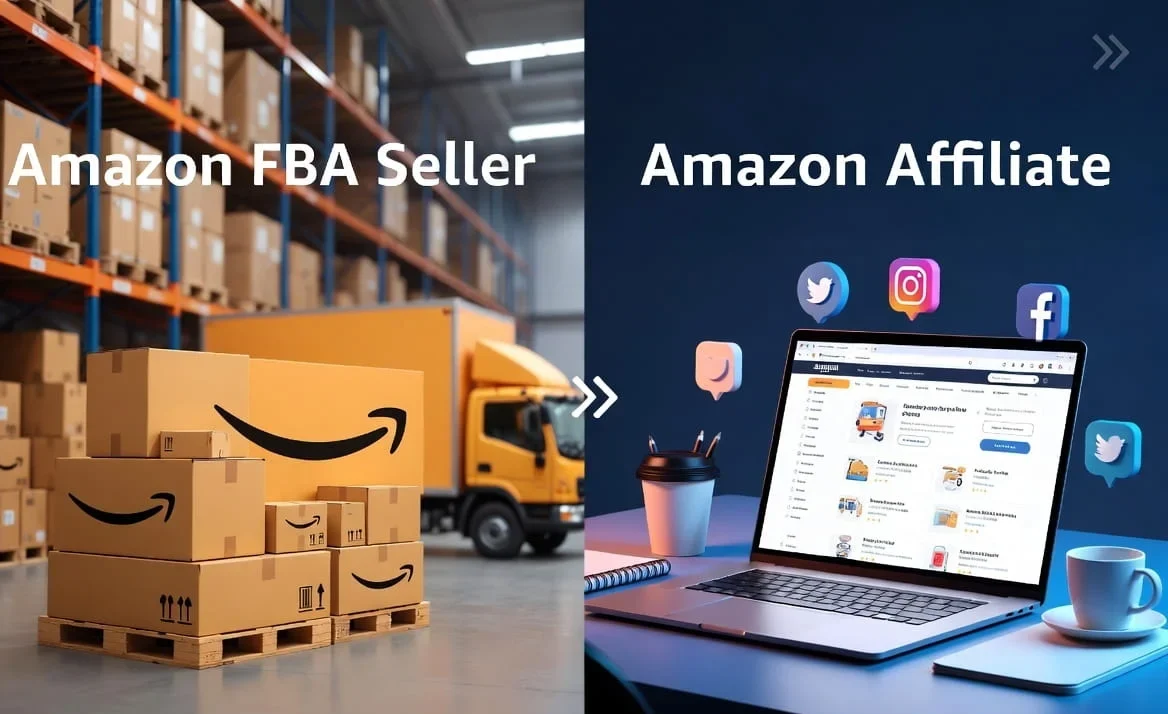
This guide breaks down the core differences, pros, cons, and earning potential of each so you can make the right call for your situation.
What Is an Amazon Affiliate?
An Amazon affiliate promotes products already listed on Amazon through unique tracking links. When someone clicks your link and makes a qualifying purchase, you earn a commission — typically between 1% and 10% depending on the product category.
You don’t hold inventory, handle shipping, or deal with customer service. Your job is to create content — blog posts, YouTube reviews, social media posts — that drives traffic to Amazon.
This model falls under the broader umbrella of affiliate marketing, one of the most popular side hustles in the US due to its low startup cost.
What Is an Amazon Seller?
An Amazon seller lists and sells physical products directly on the platform. The most popular approach is Fulfillment by Amazon (FBA), where you send your inventory to Amazon’s warehouses and they handle storage, shipping, and returns.
Sellers can source products through retail arbitrage (buying discounted goods and reselling), wholesale, or private label (building your own branded product line).
As a seller, you control pricing, branding, and margins — but you also carry more responsibility and upfront cost.
Amazon Seller vs Affiliate: Head-to-Head Comparison
💰 Startup Cost
Affiliate: Near zero. You need a website or social platform — often under $100 to launch.
Amazon Seller: Meaningful capital required. FBA sellers typically invest $1,000–$5,000+ for initial inventory, packaging, product photography, and advertising.
Winner for low budget: Affiliate marketing.
📈 Income Potential
Affiliate: Realistic beginners earn $100–$2,000/month. Top affiliates with high-traffic sites scale further, but commissions are inherently capped by category rates.
Amazon Seller: FBA sellers can build businesses generating $5,000–$50,000+/month in revenue. Private label brands can eventually be sold for significant exits. The ceiling is much higher.
Winner for income ceiling: Amazon selling.
⏱ Time to First Dollar
Affiliate: Can earn commissions within days if you already have an audience. For those building from scratch via SEO, expect 3–6 months of consistent content creation.
Amazon Seller: Product research, sourcing, shipping, and listing setup can take 1–3 months before your first sale.
Winner for speed: Affiliate marketing (with existing traffic).
🔧 Complexity and Learning Curve
Affiliate: Relatively straightforward. Learn SEO, content marketing, and FTC disclosure rules. The main skill is driving targeted traffic.
Amazon Seller: More moving parts — product research, supplier negotiations, FBA logistics, PPC advertising, listing optimization, and account health management. Higher complexity, but systems become manageable over time.
Winner for simplicity: Affiliate marketing.
📦 Risk Level
Affiliate: Minimal financial risk. Your main investment is time. Worst case — you produce content that doesn’t convert.
Amazon Seller: Real financial risk. Slow-moving inventory, FBA storage fees, hijacked listings, and account suspensions are genuine challenges US sellers face.
Winner for low risk: Affiliate marketing.
🏆 Long-Term Asset Value
Affiliate: A high-traffic affiliate site is a sellable digital asset on platforms like Empire Flippers or Flippa — typically valued at 30–40x monthly profit.
Amazon Seller: A successful private label brand with strong reviews and consistent revenue can be acquired by aggregators for 2–4x annual profit — often a more valuable exit.
Winner for asset building: Amazon selling (private label).
Who Should Choose Amazon Affiliate Marketing?
Amazon affiliate marketing is the right fit if you:
- Are starting with limited capital (under $500)
- Already create content — blogging, YouTube, or social media
- Prefer passive income over active business management
- Want to test the waters before committing serious money
- Are comfortable with SEO and organic traffic strategies
It’s especially effective for Americans in content-heavy niches like home improvement, parenting, outdoor gear, tech, and fitness — all categories with strong US buying intent.
Who Should Choose Amazon Selling?
Amazon FBA or private label selling is the right fit if you:
- Have startup capital to invest ($1,500+)
- Want to build a scalable, sellable brand
- Are comfortable with data-driven decision-making
- Have time to manage operations or outsource them
- Are thinking long-term — not just a quick side hustle
Retail arbitrage is a middle ground — lower capital to start, but more time-intensive and less scalable than private label.
Can You Do Both?
Absolutely — and many successful US earners do exactly that. A common strategy is to build an affiliate site around a niche, then launch a private label FBA product in that same niche. Your affiliate content drives organic traffic, and your Amazon listings convert that audience into buyers. You earn on both sides.
This combined approach maximizes your Amazon ecosystem exposure while spreading income risk across two models.
The Bottom Line
There’s no universally “better” option — only the better option for you.
- Choose affiliate marketing if you want low risk, minimal startup cost, and content-based income.
- Choose Amazon selling if you want higher earning potential, brand ownership, and are willing to invest upfront.
Both paths reward consistency, research, and a genuine focus on customer value. Pick the model that matches your resources right now — and remember, you’re not locked in. Many of America’s most successful Amazon earners started as affiliates and grew into sellers.
The best move is always the one you actually start.
Internal Link Suggestion: [How to Earn with Amazon: Proven Strategies for Americans →] This article is for informational purposes. Earnings vary based on individual effort, niche, and market conditions.


